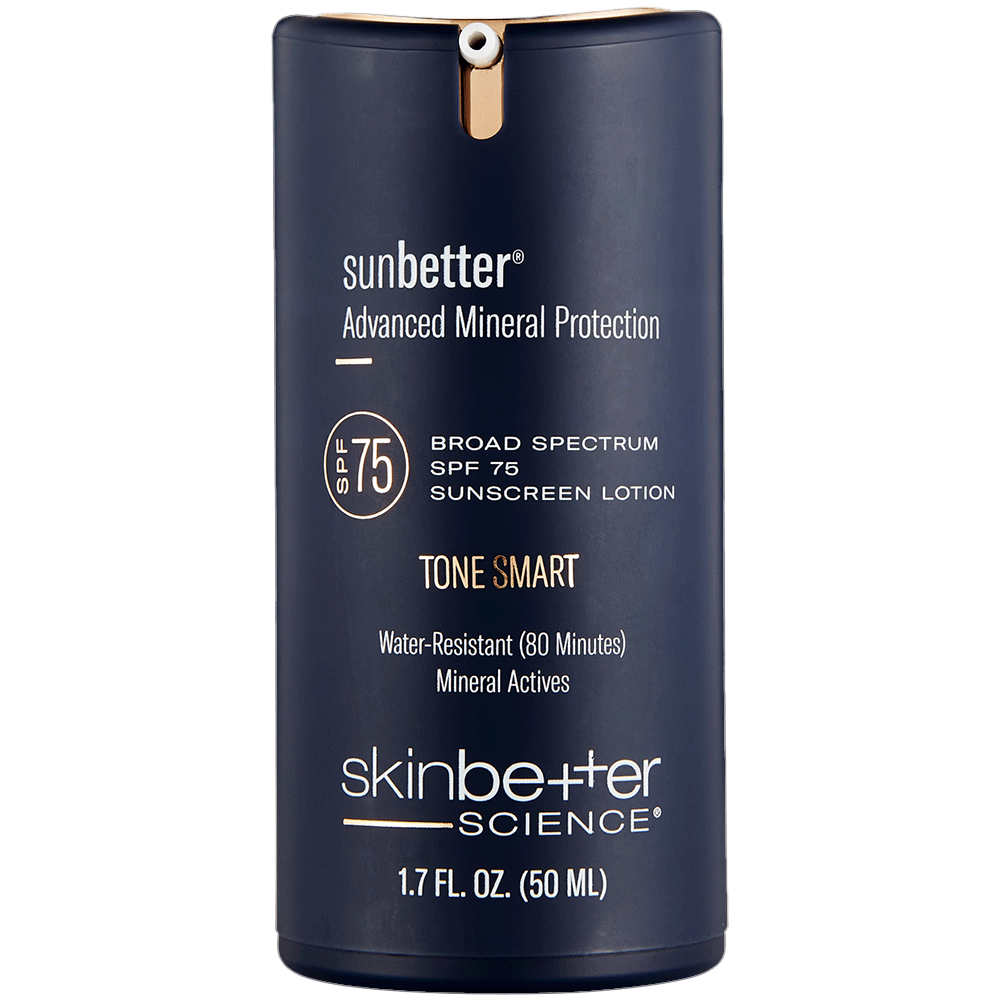
sunbetter TONE SMART SPF 75 Sunscreen Lotion
A hint of color and high mineral protection in one layer.
You want your skin to look a little more even in the morning without putting on a full layer of foundation.
TONE SMART SPF 75 gives you broad spectrum protection from 10% zinc oxide and 3.5% titanium dioxide in a creamy lotion with a sheer, tone adapting tint. The iron oxides behind the tint blend toward your skin tone and help filter visible light, and a second layer builds more coverage. It stays water resistant for 80 minutes and wears as a primer or in place of a light foundation.
Who It Is For
All skin types and tones who want protection and a little color in one step, including sensitive and post procedure skin, as skinbetter describes it.
Not Acne Safe
What You Will See, and When
The even, softly tinted finish shows up the moment it goes on. Water resistance lasts 80 minutes of swimming or sweating, and then it is time to reapply.
How to Use
Every morning, whatever the weather and whether or not you leave the house, put on your clear sunscreen first, two finger lengths for face and neck, then warm two to three pumps of TONE SMART between your fingertips and blend it over the top as your last step. Add a second thin layer wherever you want more coverage. Reapply at least every two hours, after 80 minutes of swimming or sweating and straight after towel drying, indoors and by a window too, because the film wears off. Tie it to washing your hands, and keep one by the sink and one in your bag.
The Science
The SPF number measures UVB, the light that burns. Broad spectrum means UVA is covered too, and UVA is the one that stays steady all year, passes through cloud and window glass, and reaches the depth where collagen sits. Zinc oxide and titanium dioxide are mineral filters that absorb and scatter ultraviolet light, and zinc oxide in particular covers the long UVA wavelengths and stays stable in sunlight.
Visible light, the part of sunlight you can see, can also drive pigment, especially in deeper skin tones. Sheer mineral filters let most of it through, while the iron oxides that give a tinted sunscreen its color absorb part of it. In a randomized, double blind trial of people with persistent brown patches, a sunscreen with iron oxide gave greater improvement in pigment over eight weeks than a UV only sunscreen used alongside the same brightening treatment.
SPF is measured in the lab at 2 mg of sunscreen per square centimeter of skin. In a study of real application, using half that amount brought the SPF down to roughly its square root, and a quarter of it brought it down to roughly its fourth root. Protection drops faster than the amount you skip, which is why the amount matters as much as the number. Reapplication matters for the same reason: the film wears off with time, touch and sweat, whatever the weather.
Questions
Why a Routine Made for You Works Better
General advice is written for everyone, so it has to assume nothing about you. It can tell you what is safe. It cannot tell you what will work for your skin.
Skin changes when it is challenged just enough, then given time to recover and adapt. That amount is different for every person, and it moves as your skin gets stronger. Ask too much and your skin spends its energy recovering instead of improving. Ask too little and nothing changes. Finding that point for you, and moving it at the right time, is where results come from.
Where that point sits depends on:
- Your skin: its history, how it reacts, and what it is doing today
- Your health: hormones, medications, pregnancy and any condition that changes how skin behaves
- Your lifestyle: sleep, stress, diet, sun, exercise and climate
- Your routine: what you use now, and what has and has not worked before
- Your goals: what you most want to change
- Your expectations and timeline: how soon you want to see change, and what is realistic for your skin
- Your consistency: how much time and how many steps you will keep up with, because the best routine is the one you actually do
- Your treatments: what you have had and what you have planned
A skin therapist weighs all of this, builds a routine you can keep, and adjusts it as your skin responds. That is why we guarantee our products when they are part of a routine designed by one of our skin therapists. If you have been reading general advice, bring your questions. We will help you sort out what applies to you and what does not.
Key Ingredients
Full Ingredient List
Active ingredients: Titanium Dioxide 3.5%, Zinc Oxide 10.0%. Inactive ingredients: 1,2-Hexanediol, Acrylates/Dimethicone Copolymer, Allantoin, Alumina, Bis-Vinyl Dimethicone/Dimethicone Copolymer, Bisabolol, Butyloctyl Salicylate, Camellia Oleifera Leaf Extract, Capparis Spinosa Fruit Extract, Caprylic/Capric Triglyceride, Caprylyl Glycol, Cerium Oxide, Cetyl Dimethicone, Dimethicone, Disteardimonium Hectorite, Glycerin, Himanthalia Elongata Extract, Iron Oxides (CI 77491, CI 77492, CI 77499), Mica, Niacinamide, Olea Europaea (Olive) Fruit Extract, Olea Europaea (Olive) Leaf Extract, Opuntia Ficus-Indica Stem Extract, Panthenol, Phenethyl Alcohol, Phenoxyethanol, Phenyl Trimethicone, Plankton Extract, Polyglyceryl-3 Sorbityl Linseedate, Polyglyceryl-4 Oleate, Polygonum Aviculare Extract, Polyhydroxystearic Acid, Polymethyl Methacrylate, Potassium Sorbate, Silica, Sodium Benzoate, Sodium Chloride, Squalane, Stearic Acid, Styrene/Acrylates Copolymer, Tocopheryl Acetate, Triethyl Citrate, Tropolone, Ubiquinone, Water, Zea Mays (Corn) Starch, Zingiber Officinale (Ginger) Root Extract.
References
1. Mitchnick MA, Fairhurst D, Pinnell SR. Microfine zinc oxide (Z-cote) as a photostable UVA/UVB sunblock agent. J Am Acad Dermatol. 1999;40(1):85-90. doi:10.1016/s0190-9622(99)70532-3
2. Lyons AB, Trullas C, Kohli I, Hamzavi IH, Lim HW. Photoprotection beyond ultraviolet radiation: a review of tinted sunscreens. J Am Acad Dermatol. 2021;84(5):1393-1397. doi:10.1016/j.jaad.2020.04.079
3. Castanedo-Cazares JP, Hernandez-Blanco D, Carlos-Ortega B, Fuentes-Ahumada C, Torres-Alvarez B. Near-visible light and UV photoprotection in the treatment of melasma: a double-blind randomized trial. Photodermatol Photoimmunol Photomed. 2014;30(1):35-42. doi:10.1111/phpp.12086
4. Faurschou A, Wulf HC. The relation between sun protection factor and amount of sunscreen applied in vivo. Br J Dermatol. 2007;156(4):716-719. doi:10.1111/j.1365-2133.2006.07684.x
5. Diffey BL. When should sunscreen be reapplied? J Am Acad Dermatol. 2001;45(6):882-885. doi:10.1067/mjd.2001.117385
6. skinbetter science. sunbetter Broad Spectrum SPF 75 Sunscreen Tone Smart Drug Facts label, DailyMed setid b878ee3b-6897-3c4a-e053-2995a90afed7, January 2025 (brand label data).
-
Hurry, only 4 items left in stock!