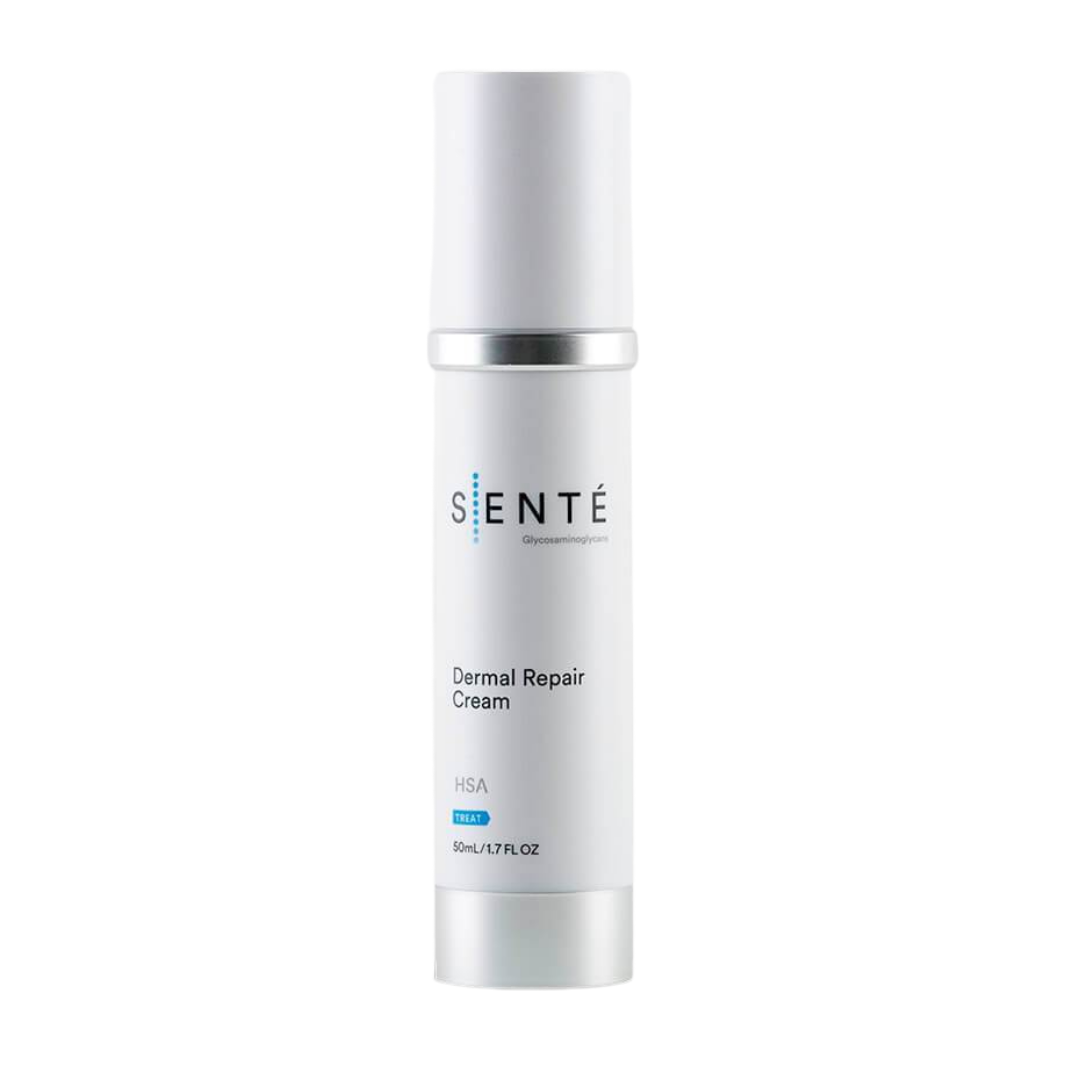
Dermal Repair Cream (TEST PAGE)
- Regular price
-
$167.00 - Regular price
-
- Sale price
-
$167.00
Your face goes red and takes forever to calm down. Every breakout leaves a brown mark that is still there months later. Your skin reacts to things that never used to bother it. And you have spent real money on moisturizers that felt lovely and changed none of it.
They are not four problems. They share a cause.
Your skin makes a molecule called heparan sulfate, and it does two jobs. It holds water inside the tissue, and it carries the repair signal, holding growth factors in position long enough to reach the cells that need them. You make less of it every year, and ultraviolet light speeds that up by switching on the enzyme that breaks it down. Sun exposed skin shows the loss. Sun protected skin on the same person does not.
That is why skin that is perfectly well moisturized can still stay red and hold onto marks. Hydration on the surface does not restore the signal underneath. It is also why the same underlying problem shows up as redness in one person, pigment in another, and reactivity in a third.
What this does about it
Heparan sulfate itself is far too large to get through skin, so for decades it was a good idea with no way in. Senté built HSA, a low molecular weight analog small enough to penetrate, and it does, within 48 hours of once daily use.
- Calms redness by binding LL-37, the peptide that sets off the inflammatory cascade behind flushing and rosacea.
- Holds hydration in the skin rather than on it.
- Works on the inflammation that drives pigment, which is what leaves a mark after a breakout.
- Supports recovery, which is why it is safe to use post procedure.
- Suitable for acne prone skin.
What you will see, and when
In a randomized, double blind trial, redness significantly improved over eight weeks, and pulsed dye laser was better tolerated than the laser alone. Applied around the eyes, discoloration and fine lines improved by week two and were still improving at week twelve.
Give it two weeks before you look for change, and twelve before you decide.
Key ingredients
How to use
Two to five pumps in the morning, five to eight at night, after your serums. Adjust for how dry you are. Warm it between your fingertips and press it in.
Moisturizer goes before sunscreen, never after.
Why we carry it
Most moisturizers pick a lane. This one holds hydration and calms inflammation at the same time, which is why it suits almost any skin and almost any routine rather than one skin type. It is also what we use post procedure, when the priority is recovery rather than actives.
The science
Heparan sulfate is a sulfated glycosaminoglycan found on cell surfaces and throughout the extracellular matrix. It acts as a co-receptor for effectively every growth factor the skin uses, FGF, EGF, VEGF, TGF-beta and HGF among them, presenting them to their high affinity receptors and protecting them from proteolytic degradation.
Ultraviolet B exposure activates heparanase, the enzyme that cleaves heparan sulfate. As it degrades in the basement membrane, that membrane loses its binding capacity for VEGF and FGF, and growth factor signalling across the dermal epidermal junction falls away. Degradation is observed in sun exposed skin and not in sun protected skin from the same subject, which is one of the mechanisms of photoaging.
In rosacea, the cathelicidin peptide LL-37 activates the NLRP3 inflammasome and drives the inflammatory cascade. LL-37 is inhibited by binding to cell surface heparan sulfate. In human epidermal keratinocytes, HSA reduced LL-37 toxicity and decreased IL-8 release.
Native heparan sulfate is large and highly polar and cannot penetrate the skin. The low molecular weight analog does, within 48 hours of once daily topical application.
Full ingredient list and format
Aqua/Water/Eau, Caprylic/Capric Triglyceride, C12-15 Alkyl Benzoate, Glycerin, Cetearyl Alcohol, Argania Spinosa Kernel Oil, Heparan Sulfate, Acetyl Glucosamine, Ethylhexyl Palmitate, Glyceryl Stearate, PEG-100 Stearate, Potassium Cetyl Phosphate, Cyclopentasiloxane, Dimethicone, Butylene Glycol, Tocopheryl Acetate, Tocopherol, Sodium Hyaluronate, Camellia Sinensis Leaf Extract, Chenopodium Quinoa Seed Extract, Acrylates/C10-30 Alkyl Acrylate Crosspolymer, Aminomethyl Propanol, Sodium Benzoate, Sorbic Acid, Potassium Sorbate, 1,2-Hexanediol, Caprylyl Glycol, Phenoxyethanol, Disodium EDTA.
Pump bottle. Medium weight, absorbs without residue. Fragrance free. Approximate pH 5.5. Sits under makeup and under sunscreen.
References
1. George R, Gallo RL, Cohen JL, et al. Reduction of erythema in moderate-severe rosacea by a low molecular weight Heparan Sulfate Analog (HSA). J Drugs Dermatol. 2023;22(6):546-553.
2. Iriyama S, et al. Activation of heparanase by ultraviolet B irradiation leads to functional loss of basement membrane at the dermal-epidermal junction in human skin. Arch Dermatol Res. 2011;303(4):253-261.
3. Bucay V, Gold MH, Andriessen A. Low molecular weight heparan sulfate containing facial skin care for reducing inflammation and restoring aged-skin homeostasis. J Cosmet Dermatol. 2020;19(8):1851-1856.
4. Bernfield M, et al. Functions of cell surface heparan sulfate proteoglycans. Annu Rev Biochem. 1999;68:729-777.
Questions
Couldn't load pickup availability